73.7% of Japanese high schoolers use AI, but weaker thinking
Whether you're a parent, an educator, or an organization building the next generation of talent, the signal here is clear. Here's what to do with it:
Source: Gakken Research Institute for Learning and Education
Study: Online survey, January 2026
Key Findings:
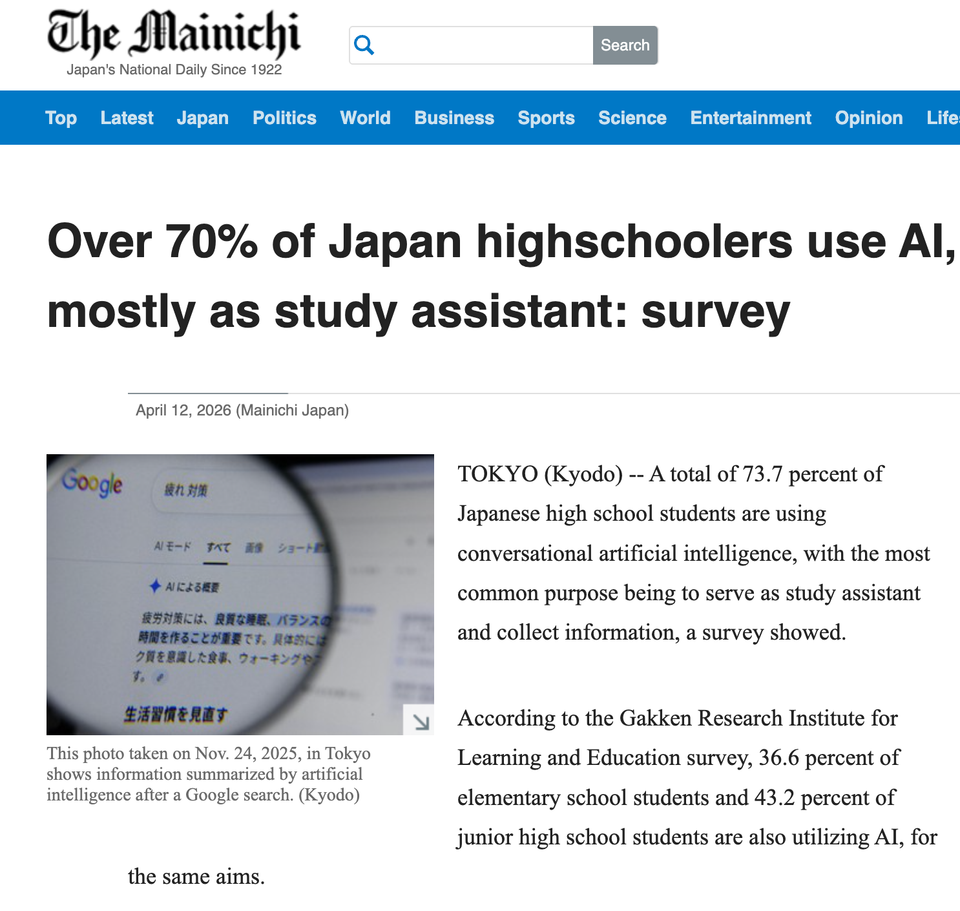
- 73.7% of Japanese high school students use conversational AI compared to 43.2% of junior high students and 36.6% of elementary students
- The top uses for high schoolers: 42.3% use AI to help with studying and homework, 26.0% to find information
- Elementary students use AI differently 44.0% for finding information, 32.6% for study help, and 23.7% to create illustrations and images
- When asked how AI affected their thinking ability, the most common response across all ages was "no particular change" but high schoolers stood out: they were more likely to say their thinking had weakened than strengthened
- Elementary and junior high students were more likely to report their thinking had improved, the inverse pattern of high schoolers
- A separate January 2026 survey of 1,200 students found nearly 80% of junior and senior high school students use generative AI "frequently" or "occasionally" and roughly 1 in 5 relies entirely on AI to provide answers or perform calculations
- 49.9% of girls use AI for advice or conversation, more than double the rate of boys (23.0%)
Cognitive science professor Hiroyuki Masukawa of Aoyama Gakuin University called for stronger AI literacy: "It is essential to ensure children can use the technology as an assistant to help improve their thinking ability"
Risks & Advantages:
This data points to something organizations and parents need to take seriously. The students using AI the most are high schoolers, the ones with the highest cognitive demands...